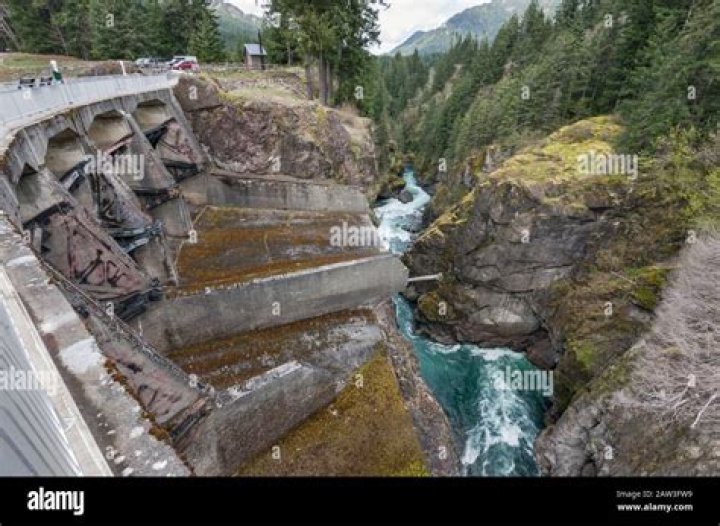
It impounded Lake Mills reservoir. The dam was demolished in 2014 as part of the Elwha River ecosystem restoration project; as of 2015 it is the tallest dam ever to be intentionally breached. The Glines Canyon Dam was the largest dam removal ever….
| Glines Canyon Dam | |
|---|---|
| Added to NRHP | December 15, 1988 |
Has the Elwha Dam been removed?
After two decades of planning, the largest dam removal in U.S. history began on September 17, 2011. Six months later the Elwha Dam was gone, followed by the Glines Canyon Dam in 2014. Today, the Elwha River once again flows freely from its headwaters in the Olympic Mountains to the Strait of Juan de Fuca.
What resulted from the Elwha Dam removal project?
An estimated two-thirds of the sediment behind the dams has now moved downstream, with 90 percent of it reaching coastal habitats. Pess says the most dramatic impact of the removal of the dams has been the recreation of the estuary, which has moved the mouth of the river about half a mile further out, he says.
What were some of the positive consequences of removing the Glines Canyon Dam in Washington state?
It was really surprising to us how fast things changed. We have seen an increase in good habitat by about a hundred acres (40 hectares) and an immediate response in the fish community. We found new species coming to the area within weeks of the dam removal starting.
When was the Glines Canyon Dam removal?
On September 17, 2011, the beginning of dam removal was celebrated at a groundbreaking ceremony attended by Secretary of the Interior Ken Salazar, as well as numerous dignitaries and approximately 400 guests. Removal work on the Glines Canyon Dam began September 15, 2011 and on the Elwha Dam on September 19, 2011.
What dam was removed in Washington state?
Elwha Dam
| Elwha Dam | |
|---|---|
| Location | Clallam County, Washington, USA |
| Construction began | 1910 |
| Opening date | 1913 |
| Demolition date | 2012 |
Who removed Elwha dam?
Starting in 2011, the National Park Service removed two obsolete dams from the Elwha River in Olympic National Park, Washington. It was the world’s largest dam-removal project.
How much did it cost to remove Elwha dam?
The estimated cost of removing both dams was $40 to $60 million. The total cost of the Elwha River restoration is approximately $351.4 million.
Who owned the Elwha dam?
The Zellerbach – now Nippon – paper mill owned both dams from 1937 to 2000, when they were sold to the US Dept of the Interior. Since 1949, the only customer for the electricity the dams produced has been the mill. Until the dams were shut down in 2011, the Elwha River dams had supplied 40% of the mill’s electricity.
Where is the largest dam removal project in the US located?
In the Olympic National Park in Washington State, removals of two large dams on the Elwha River were completed in 2014, restoring 75% of previously inaccessible spawning habitat.
Why is dam removal important?
When a dam no longer serves its intended purpose, removing it provides an opportunity for us to return a river to its original state, where natural systems are allowed to work without barriers.
What changes did the removal of the dams cause to the Elwha River and the surrounding environment?
The loss of fish habitat caused by the dams contributed to steep decline in native fish populations and habitat quality. The Lower Elwha Klallam Tribe, whose culture is closely connected to the salmon runs and surrounding land, was negatively impacted by the dams.
How was the Glines Canyon Dam removed?
Removal of Glines Canyon Dam: First, water levels in the Lake Mills reservoir were lowered to the bottom of the spillway gates. Using barge-mounted hydraulic hammers, the first 17 feet of the dam were removed down to the waterline. The next 173 feet of the dam were removed using a notching process.
Can a river recover after a dam is removed?
Even without exceptional flows, a river can recover very rapidly after removing a dam or two.” Glines Canyon Dam on the Elwha River, during dam removal. (Credit: Jeff Duda, U.S. Geological Survey, public domain.)
What are the impacts of dam removal on the Elwha River?
Other recent USGS-led publications on the impacts of Elwha dam removal include “ Coastal habitat and biological community response to dam removal on the Elwha River ,” and “ Increased sediment load during a large-scale dam removal changes nearshore subtidal communities .” For more information on USGS Elwha River research, visit our website.
What was the world’s largest dam-removal project?
Starting in 2011, the National Park Service removed two obsolete dams from the Elwha River in Olympic National Park, Washington. It was the world’s largest dam-removal project.