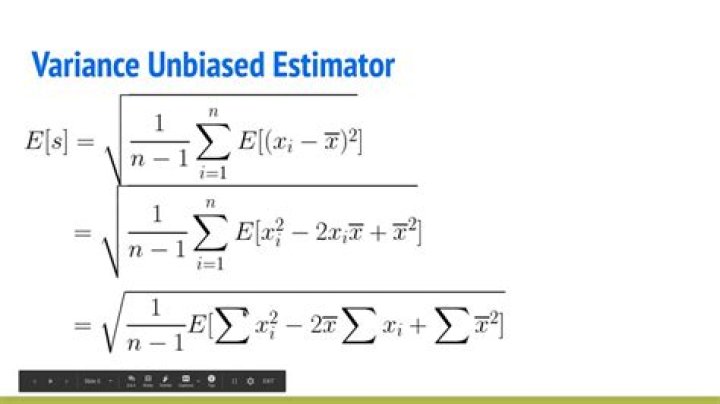
In other words, the expected value of the uncorrected sample variance does not equal the population variance σ2, unless multiplied by a normalization factor. The sample mean, on the other hand, is an unbiased estimator of the population mean μ. , and this is an unbiased estimator of the population variance.
Why is the unbiased estimator of variance used?
the unbiased estimator of the population variance, corrects the tendency of the sample variance to underestimate the population variance. called the sample standard deviation, is calculated from the biased sample variance.
How do you calculate an unbiased estimator?
Unbiased Estimator
- Draw one random sample; compute the value of S based on that sample.
- Draw another random sample of the same size, independently of the first one; compute the value of S based on this sample.
- Repeat the step above as many times as you can.
- You will now have lots of observed values of S.
What is unbiased sample variance?
In estimating the population variance from a sample when the population mean is unknown, the uncorrected sample variance is the mean of the squares of deviations of sample values from the sample mean (i.e. using a multiplicative factor 1/n). gives an unbiased estimator of the population variance.
Is s an unbiased estimate of σ?
Nevertheless, S is a biased estimator of σ. You can use the mean command in MATLAB to compute the sample mean for a given sample.
What is the bias and variance of an estimator?
• Bias and Variance measure two different. sources of error of an estimator. • Bias measures the expected deviation from the. true value of the function or parameter. • Variance provides a measure of the expected.
Can a biased estimator be efficient?
The fact that any efficient estimator is unbiased implies that the equality in (7.7) cannot be attained for any biased estimator. However, in all cases where an efficient estimator exists there exist biased estimators that are more accurate than the efficient one, possessing a smaller mean square error.
When and why are unbiased estimators preferred over biased estimates?
An unbiased statistic is generally preferred over a biased statistic for estimating the population characteristic because the mean value of the unbiased statistic is equal to the value of the population characteristic being estimated.
Which statistics are unbiased estimators?
An unbiased estimator is a statistics that has an expected value equal to the population parameter being estimated. Examples: The sample mean, is an unbiased estimator of the population mean, . The sample variance, is an unbiased estimator of the population variance, .
Is S2 an unbiased estimator of the variance?
By the above discussion, S2 is an unbiased estimator of the variance. We call it the sample variance.
What are unbiased estimators of population parameters?
A statistic is called an unbiased estimator of a population parameter if the mean of the sampling distribution of the statistic is equal to the value of the parameter. For example, the sample mean, , is an unbiased estimator of the population mean, . In symbols, .
How do you find the unbiased sample variance?
Step 1: Calculate the mean (the average weight). Step 2: Subtract the mean and square the result. Step 3: Work out the average of those differences.
How to find an unbiased estimator?
One way to determine the value of an estimator is to consider if it is unbiased. This analysis requires us to find the expected value of our statistic. We start by considering parameters and statistics. We consider random variables from a known type of distribution, but with an unknown parameter in this distribution.
What does “unbiased estimator” mean?
An estimator of a given parameter is said to be unbiased if its expected value is equal to the true value of the parameter. In other words, an estimator is unbiased if it produces parameter estimates that are on average correct.
How do you estimate variance?
Find the Mean. To determine the variance, for example, in the distances between your town and three others, first find the average distance. If the individual distances are 12, 18, and 27 miles, add them together and divide by the number of data points.
What are some concepts behind variance analysis?
Variance analysis is usually associated with explaining the difference (or variance) between actual costs and the standard costs allowed for the good output. For example, the difference in materials costs can be divided into a materials price variance and a materials usage variance.