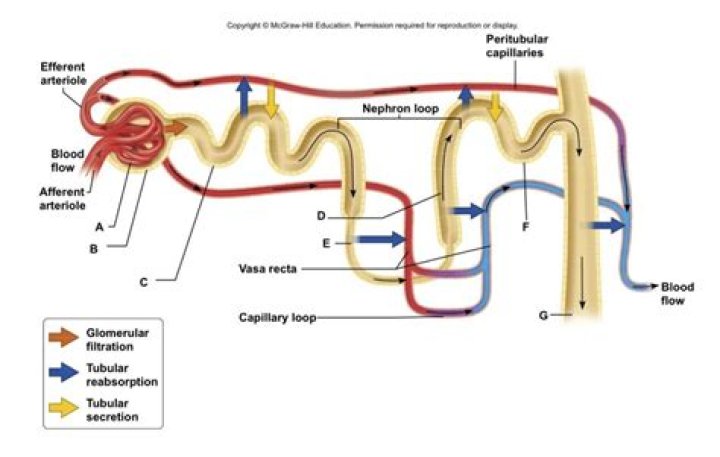
tubular secretion. the passage of substances from the blood in the peritubular capillaries to the tubular filtrate. Functions of tubular secretion. elimation of waste products not filtered by the glomerulus and regulation of the acid-base balance in the body through the secretion of hydrogen ions.
What is tubular secretion and tubular reabsorption?
The key difference between tubular reabsorption and tubular secretion is that tubular reabsorption involves the removal of some solutes and water from the tubular fluid and their return to the blood, while tubular secretion involves the removal of hydrogen, creatinine, and drugs from the blood and return to the …
What does secretion mean in the kidney?
Waste Ions and Hydrogen Ions Secreted from the Blood Complete the Formation of Urine. At the same time, waste ions and hydrogen ions pass from the capillaries into the renal tubule. This process is called secretion. The secreted ions combine with the remaining filtrate and become urine.
What happens in active tubular secretion?
Active tubular secretion is a carrier-mediated transport system, located in the proximal renal tubule. It requires energy input because the drug is moved against a concentration gradient. Two active tubular secretion systems have been identified: anion secretion for acids and cation secretion for bases.
Why is tubular secretion important?
Tubular secretion is one of many steps in the process of filtering blood to produce liquid waste in the form of urine. Within the excretory system of many organisms, this is important for both waste removal and acid-base balance.
What describes tubular reabsorption?
Tubular reabsorption is the process that moves solutes and water out of the filtrate and back into your bloodstream. This process is known as reabsorption, because this is the second time they have been absorbed; the first time being when they were absorbed into the bloodstream from the digestive tract after a meal.
What is meaning of tubular reabsorption?
What is the significance of tubular secretion?
What is renal tubular function?
Listen to pronunciation. (REE-nul TOO-byool) One of millions of tiny tubes in the kidneys that returns nutrients, fluids, and other substances that have been filtered from the blood, but the body needs, back to the blood. The remaining fluid and waste in the renal tubules become urine.
What is the purpose of tubular reabsorption?
Where does ultrafiltration occur?
kidneys
In renal physiology, ultrafiltration occurs at the barrier between the blood and the filtrate in the glomerular capsule (Bowman’s capsule) in the kidneys.
What is meant by tubular secretion?
tubular secretion. The passage of unneeded substances from the peritubular capillaries into the tubule of the nephron and hence into the urine.
What is the purpose of tubular secretion?
The purpose of tubular secretion is to regulate blood ph (by the secretion of the hydrogen ions) and removing unwanted substances from the body such as uric acid & ammonium . In other words the role of tubule secretion is to eliminate. This preview has intentionally blurred sections.
How is tubular fluid becomes urine?
When tubular fluid leaves the renal tubule it goes to the collecting tubule (or collecting duct). At this stage the tubular fluid becomes urine. The renal tubule of several nephrons drain into the collecting tubule. This results in a significant amount of water being drained into the collecting tubule.
How does tubular re-absorption and tubular secretion differ?
The key difference between tubular reabsorption and tubular secretion is that tubular reabsorption involves the removal of some solutes and water from the tubular fluid and their return to the blood, while tubular secretion involves the removal of hydrogen, creatinine, and drugs from the blood and return to the collecting duct.