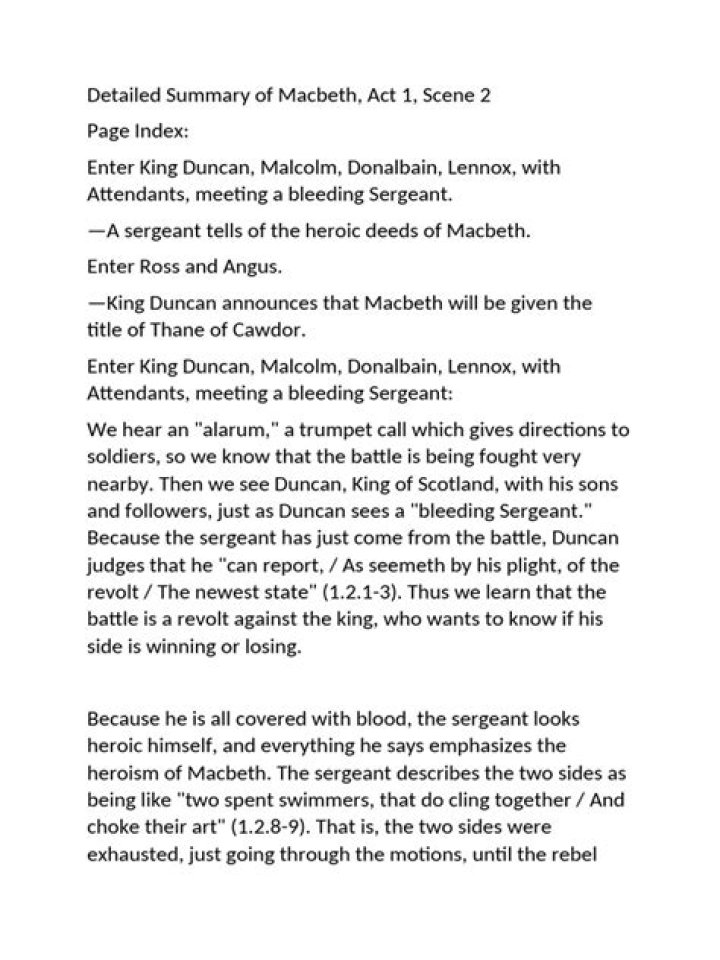
In Act 1, Scene 2 of Macbeth, a wounded officer brings King Duncan news of Macbeth’s bravery in battle. He also tells how the Thane of Cawdor betrayed the King by helping the Norwegian army. King Duncan orders the captured traitor, the Thane of Cawdor, be executed, and his title be given to Macbeth.
What does Duncan think of Macbeth in Act 1 Scene 2?
Duncan proclaims that the traitorous Thane of Cawdor shall be put to death, and that Macbeth shall be made Thane of Cawdor. Duncan rewards and trusts his subjects. This is the opposite of personal ambition. Ironically, though, he replaces one traitor with a much worse traitor.
What does Duncan decide to give to Macbeth in Act 1 Scene 2 and why?
While the Captain is taken off for medical help, two thanes enter – Ross and Angus – and announce that Macbeth has also conquered the Norwegian army, including the Thane of Cawdor, a traitor. Overjoyed at the news, Duncan decides to bestow Cawdor’s title on Macbeth, and to execute the former thane.
What happens in Act 1 scenes 1 and 2 of Romeo and Juliet?
Act 1 Scene 2 Paris visits Lord Capulet to ask for Juliet’s hand in marriage. Lord Capulet thinks Juliet is too young to marry saying to Paris ‘Let two more summers wither in their pride, / Ere we may think her ripe to be a bride’. However, he later encourages Paris to woo her at a ball at his house.
What is the main idea of Act 1 in Romeo and Juliet?
Love versus hate and the many forms love takes; its power to challenge hate; the impetuosity of young love; the irrationality of hate and its capacity to destroy love. Some related scenes: Act 1, Scene 1: The Capulets and Montagues fight in Verona’s marketplace; Romeo tells Benvolio of his unrequited love for Rosaline.
What happened in Act 1 Scene 1 of Macbeth?
Summary: Act 1, scene 1 Thunder and lightning crash above a Scottish moor. Three haggard old women, the witches, appear out of the storm. In eerie, chanting tones, they make plans to meet again upon the heath, after the battle, to confront Macbeth. As quickly as they arrive, they disappear.
What is the dramatic purpose of Act II Scene II in Macbeth?
In Act II scene II, Shakespeare uses tension and dramatic interest along with stage effects and language techniques to illustrate how Macbeth, with the help of Lady Macbeth influencing him to do so, commit the dreadful murder of King Duncan, and the after effects of this deed.
What is the dramatic purpose of Act 2 Scene 2 in Macbeth?
The dramatic tension of this scene brings the audience to the edge of their seats with anticipation, awaiting the news of King Duncan’s death. In Act 2, scene 2 only two characters are on stage, Macbeth and Lady Macbeth.
What happens in Act 1 Scene 2 of Macbeth?
Macbeth Act 1, scene 2 Summary & Analysis. The blood covering the captain makes him an unrecognizable monster, just as Macbeth, who in this scene is described as a noble hero who is brave and loyal to his king, will be transformed into a monster as he becomes “covered” with the metaphorical blood of those he kills to achieve his ambitions.
What happens in Act 1 Scene 2 of Romeo and Juliet?
Summary: Act 1, scene 2. Before departing, Peter invites Romeo and Benvolio to the party—assuming, he says, that they are not Montagues. Benvolio tells Romeo that the feast will be the perfect opportunity to compare Rosaline with the other beautiful women of Verona. Romeo agrees to go with him, but only because Rosaline herself will be there.
Why does Romeo agree to go with Juliet to the feast?
Romeo agrees to go with him, but only because Rosaline herself will be there. This scene introduces Paris as Capulet’s pick for Juliet’s husband and also sets into motion Romeo and Juliet’s eventual meeting at the feast. In the process, the scene establishes how Juliet is subject to parental influence.
How is Juliet subject to parental influence in Romeo and Juliet?
This scene introduces Paris as Capulet’s pick for Juliet’s husband and also sets into motion Romeo and Juliet’s eventual meeting at the feast. In the process, the scene establishes how Juliet is subject to parental influence. Romeo might be forced into fights because of his father’s enmity with the Capulets, but Juliet is far more constrained.